Blog Archives
Movies & Racism
What can white people do?
As a white person, what can I do to contribute to the conversation on racism? I’m already passionate about human rights, civil rights, equal rights and justice for all. Protesters march the streets condemning police brutality, calling for better treatment of black men and women. Just as people of different colors, races and religions marched with raised fists supporting our black brothers and sisters, white people need to continue the conversation on racism.
It’s not enough for black people to discuss racism with other black people. The beauty blossoming from the Black Lives Matter protests is the unity, and not just in America, but around the entire world. The entire world is shouting, “ENOUGH IS ENOUGH!”
Racism is a global sickness. Protesters, wearing protective masks, have often mentioned their concern about COVID-19, but racism has been around for over 400 years. Their fight for racial justice is more important. They would die for this cause as many have for many years. Hate is a virus.
Black men in particular have been treated unfairly. It has been difficult at times in some cases to witness any justice whatsoever. A lot needs to improve. I may not be able talk specifically about racial justice or police reform, but my experience and passion is the movies.
Having discussions about racism in movies is a great way to talk about the issues. Just as there is a lot of racial history in America, there’s a lot of movies about the topic.
Documentaries
“Broken On All Sides”
Broken On All Sides: Race, Mass Incarceration & New Visions for Criminal Justice in the U.S. (Trailer) from Collective Eye Films on Vimeo.
In 2012, I ran the Social Media Film Festival in Las Vegas, Nevada. The festival was about social media taking on social issues. One documentary film in particular, “Broken On All Sides: Race, Mass Incarceration & New Visions for Criminal Justice in the U.S.” focuses on a book by Michelle Alexander, The New Jim Crow. Michelle Alexander’s book focuses on how the war on drugs and tough on crime policies targeted people of race, specifically black men. If these same black men completed their time, they had very little chances of employment or improving their lives once released back into society.
Prisons became a place of overcrowded cells. Many simply could not afford to bail themselves out and ended up doing more time. “Broken On All Sides” can be viewed on Vimeo. The director, Matthew Pillischer, shared this link and password (broken) to let anyone watch this important documentary.
“I Am Not Your Negro”
In 1979, James Baldwin turned in an unfinished manuscript entitled, “Remember This House.” The book was to be a first hand personal account of three very outspoken black activists; Medgar Evers, Malcom X and Martin Luther King, Jr. Filmmaker Raoul Peck took the unfinished manuscript and turned it into this very intelligent and insightful documentary narrated by Samuel L. Jackson. “I Am Not Your Negro” was nominated for an Oscar at the 2017 Academy Awards. James Baldwin: “The story of the Negro in America is the story of America, and it is not a pretty story.”
Ava DaVernay
“13th,” an Oscar nominated documentary by Ava DuVernay, discusses mass incarceration and racial inequality. The title, ‘13th’ refers to the thirteenth amendment of the United States Constitution to abolish slavery unless it is punishment for a crime. The amendment was passed on January 31, 1865 and made official on December 6, 1865. Michelle Alexander (“Broken On All Sides”) is a subject in this film too.
“Selma”
Another Oscar nominated film by Ava DaVernay is “Selma.” “Selma” (2014) is the narrative story of Martin Luther King, Jr. pursuing a campaign to achieve equal voting rights for black people. King, played wonderfully by David Oyelowo, lead a large march of mostly black people from Selma to Montgomery, Alabama in 1965. President Johnson signed the Voting Rights Act into law. It is an extraordinary and powerful portrayal of a man looking to make peaceful change in the world.
“Green Book”
Another movie taking place in the 1960s is “Green Book.” Director Peter Farrelly is a story that tackles both issues of racism and homophobia. Tony Vallelonga, (Viggo Mortensen) a nightclub bouncer, reluctantly takes a job driving a classical pianist, Don Shirley (Mahershala Ali) on a tour of the deep southern states. Their main resource for their journey is The Negro Motorist Green Book, a travel guide for black people looking to be safe in the segregated south. By the end of the film these two strangers become very close. They may have not changed the world, but they changed each other’s world for the better.
“It takes courage to change peoples’ hearts.”
It’s an excellent film! Don Shirley is masterfully portrayed by Mahershala Ali who won an Oscar for an Actor in a Supporting Role. Viggo Mortensen was also nominated for the Leading Role.
Spike Lee – “Do the Right Thing”
As far as I know, whenever Spike Lee is mentioned “Do the Right Thing” in 1989 is the movie that always comes to mind. It is so powerful and important. It takes place on a very hot Summer’s day in a Brooklyn, NY neighborhood where tempers often rise due to racial conflict. Sal, Italian, played by Danny Aiello, owns a pizza parlor where it’s patrons are mostly black and Hispanic. His son, Pino, (JohnTurturo) would love nothing more than to move their pizza place to their Italian neighborhood.
When one of the black customers, Buggin Out (Giancarlo Esposito) looks up at the famous people in pictures on the wall he points out there’s no black people. Sal reminds him there’s only Italians because it’s an Italian establishment. Things get heated throughout the day. Mookie (Spike Lee), Sal’s delivery driver, is friendly with Buggin Out, putting him in a tough spot.
The rest of this amazing cast includes; Ossie Davis, Ruby Dee, Bill Nunn, Samuel L. Jackson, Rosie Perez, Martin Lawrence and John Savage. ‘Fight the Power,” a strong political song by Public Enemy is still very relevant.
“BlackkKlansman”
Spike Lee has gone on to make numerous films about racism including “Malcolm X,” but my second favorite film of his is his more recent “BlackkKlansman” in 2018. As incredible as it sounds, this movie is based on true events. It’s about, Ron Stallworth, the first black officer hired in the early 1970s at the Colorado Springs, Colorado police department. Stallworth, played by John David Washington, working in the records room, is sick of hearing racial insults from his co-workers. He decides to switch to undercover work in a big way. He simply calls up the grand master of the KKK, David Duke, and state how much he hates blacks, Jews, Mexicans, etc. He forms an instant bond with Duke, but he can’t meet with Duke in person for obvious reasons. So his white, Jewish partner, played by Adam Driver, uses his name to go undercover to infiltrate and expose the KKK.
Steve McQueen’s “12 Years a Slave”
Solomon Northrop, played by Chiwetel Ejiofor, is a black man born free in upstate New York. Northrop, a professional violin player, thought he was meeting with some men about a job opportunity, but was mislead, abducted and sold back into slavery. It is an unbelievably true story showing one man’s struggle and survival for a right to win back the freedom he already had. The amazing cast includes Michael Fassbender, Paul Giamatti, Benedict Cumberbatch, Paul Dano, Brad Pitt, Sarah Paulson, Alfre Woodard, and Lupita Nyong’o. A fellow slave in captivity advises Northop, “If you want to survive, do and say as little as possible.” Northrop answers, “I don’t want to survive. I want to live.”
Jordan Peele’s “Get Out”
This is a horror story about a white girl named Rose Armitage who brings her black boyfriend, Chris Washington, home to meet her parents. Chris, played by Daniel Kaluuya, is concerned about meeting Rose’s white parents and family. Her parents make him feel comfortable. Too comfortable. A party with guests has some strange aspects to it and even stranger characters. Black male and female servants act like they only speak when spoken to. Rose’s mother, played by Catherine Keener, is some sort of psychologist. When Chris mentions to her parents he’s trying to quit smoking Mrs. Armitage offers Chris tea to take him to his ‘sunken place.’ Chris learns the hard way that Rose’s family have bad intentions for him. There are levels of deceit, manipulation and blatant racism throughout this story.
Movies That Matter
In the spirit of my Social Media Film Festival, I started Movies That Matter LA Meetup in 2015 through 2016. It was a movie group with screenings about social issues. The idea of the group was to see a movie and discuss it afterwards. Movies touched on climate change, prescription drugs, anti-semitism and racism. Three films regarding racism during that time were “Loving,” “Hidden Figures” and “3 1/2 Minutes, Ten Bullets.”
“Loving”
“Loving” is based on the true story of Richard Loving, portrayed by Joel Edgerton, who falls in love with a black woman named Mildred (Ruth Negga) in the 1960s. They decide to drive up to Washington DC to get officially married. The couple was arrested for being an interracial marriage in Virginia. Loving began a legal battle that would end with the Supreme Court’s historic 1967 decision to make interracial marriage legal.
“Hidden Figures”
“Hidden Figures” is the unbelievable story about three black female mathematicians highly responsible for the success of astronaut John Glenn into orbit. The space race in the 60s between the Soviet Union and the United States was fierce. The times were intense, but even more so for these women as they had to not only prove themselves under duress, they had to battle many racial biases. Simple things like going to the restroom weren’t so simple for black women. They had to walk great distances to relieve themselves. These extremely intelligent women, Katherine G. Johnson, Dorothy Vaughan and Mary W. Jackson, were performed beautifully by Taraji P. Henson, Octavia Spencer and Janelle Monae. It’s a very inspiring story.
On Wednesday, June 24th, 2020, NASA Administrator, Jim Bridenstine announced the agency’s headquarters building in Washington, D.C. to be named after Mary W. Jackson, honoring her as the first African American female engineer at NASA. Additionally, Jackson was posthumously awarded the Congressional Gold Medal in 2019.
Bridenstine stated, “Mary W. Jackson was part of a group of very important women who helped NASA succeed in getting American astronauts into space. Mary never accepted the status quo, she helped break barriers and open opportunities for African Americans and women in the field of engineering and technology. Today, we proudly announce the Mary W. Jackson NASA Headquarters building. It appropriately sits on ‘Hidden Figures Way,’ a reminder that Mary is one of many incredible and talented professionals in NASA’s history who contributed to this agency’s success. Hidden no more, we will continue to recognize the contributions of women, African Americans, and people of all backgrounds who have made NASA’s successful history of exploration possible.”
Ryan Coogler’s “Fruitvale Station”
Sundance winner “Fruitvale Station,” written and directed by a Ryan Coogler (“Black Panther,” “Creed”), is a true story about 22-year old, Oscar Grant, played beautifully by Michael B. Jordan. Grant wakes up on the last day of the year, December 31, 2008, thinking about his future and improving his life. Recently unemployed, he wants to be there more for his four year old daughter, Tatiana, and be a better boyfriend to his live-in girlfriend, Sophina. Grant spends much of the day preparing for his mother’s birthday party. After the party, his mother, Wanda, (Octavia Spencer) talks Grant into to taking the BART train over driving because of all the NYE drivers drunk drinking. The unfortunate incident shows how the police officers shot an unarmed Grant and used excessive force.
“Just Mercy”
Michael B. Jordan is also the lead in “Just Mercy” about a young lawyer, Bryan Stevenson, who, after graduating from Harvard, decides to defend the wrongly accused in Alabama instead of taking potentially more lucrative financial job opportunities. One of his notorious cases involved Walter McMillian, on death row for murdering an eighteen year old girl. The only testimony against McMillian played by Jaime Foxx, is of a criminal with a motive to lie. There are a lot of things hindering Stevenson’s progress in this and other cases. One thing you learn about Stevenson is that he never quits. “It’s never too late for justice.”
“3 1/2 Minutes, 10 Bullets”
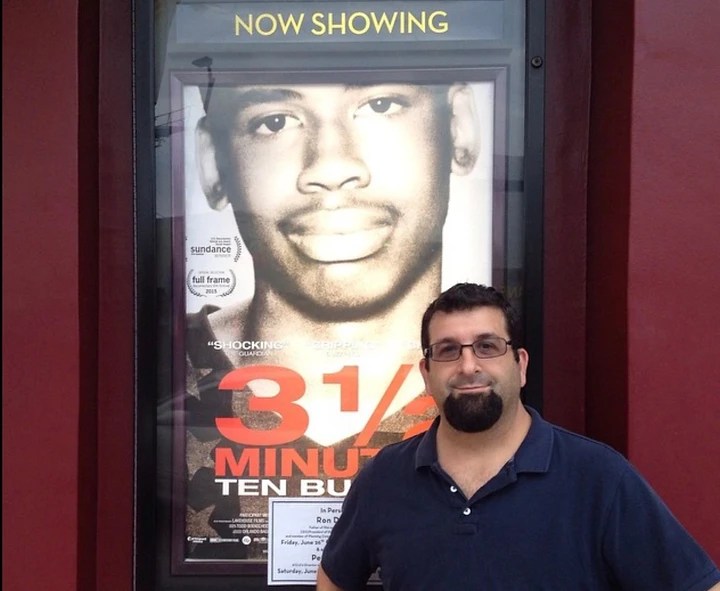
The last movie I’ll share is another documentary film, “3 1/2 Minutes, Ten Bullets” directed by Marc Silver. In November 2012, four young black teenagers pulled up to a gas station in a red SUV. Their music was blaring. Another vehicle pulled up with a white couple inside. The woman entered the store. The middle-aged male driver, Michael Dunn, started a shouting match with the boys about their music. Three and a half minutes and ten bullets later, seventeen-year old Jordan Davis was dead.
It’s just one event in an endless string of endless of similar occurrences where both black men and women should have no reason to lose their lives over the smallest things or nothing at all.
Police Brutality
Police officers are now wearing body cams. Those cams need to be recording all incidents out of protection for both the officer and the person they’re arresting, displaying exactly what goes down. It’s not that black people haven’t been victimized the last several decades. Arrests are now being recorded by the police themselves, but more importantly THE PEOPLE. The people are recording everything even before anything happens, using their cell phones. They anticipate something happening because their trust of the police has diminished.
After seeing the body cams of the police officers before and during the George Floyd arrest, people stood up. Eight minutes and forty-six seconds was a long time to watch a Minneapolis police officer place a chokehold on Mr. Floyd. Not only did black people stand up, but they started marching. They were not the only people that stood up and started marching. Brown people stood up. Asian people stood up. And white people stood up. By and large, Americans, Europeans, and human beings all over the world felt and shouted “Enough is enough!”
In Summary, here is a list of films in the order presented in this blog about racism people of all ethnic backgrounds can view to discuss the issues further.
- “Broken On All Sides”
- “I Am Not Your Negro”
- “13Th”
- “Selma”
- “Green Book”
- “Do the Right Thing”
- “BlackkKlansman”
- “12 Years a Slave”
- “Get Out”
- “Loving”
- “Hidden Figures”
- “Fruitvale Station”
- “Just Mercy”
- “3 1/2 Minutes, 10 Bullets”
What else can white people do?
Donate & Share Fundraising Campaigns #HateIsAVirus
Where to Donate for Black Lives Matter
https://nymag.com/strategist/article/where-to-donate-for-black-lives-matter.html
Justice for Breonna Taylor Go Fund Me #SayHerName
https://www.gofundme.com/f/9v4q2-justice-for-breonna-taylor
Official George Floyd Memorial Fund
https://www.gofundme.com/f/georgefloyd
Ahmaud Arbery Go Fund Me
https://www.gofundme.com/f/i-run-with-maud
Official Go Fund Me for Rayshard Brooks
https://www.gofundme.com/f/official-gofundme-for-rayshard-brooks
American Civil Liberties Union
https://action.aclu.org/give/now
Equal Justice Initiative
NASA Resource for “Hidden Figures”
https://www.nasa.gov/press-release/nasa-names-headquarters-after-hidden-figure-maryw-jackson
https://www.naacpldf.org/support/
Share this:

Let’s All Go to the Movies

Let’s All Go to the Movies!
It’s Saturday night. You and your significant other plan a night out at the movies. It’s tradition! Most of you plan to see a new release. Cinephiles may be seeing an old movie like “The Godfather” on the big screen. Maybe you’re out with friends, sharing a common interest in a particular movie. A part of the excitement is simply getting cozy in a dark theater with your favorite snacks and drinks. And then take a ‘most excellent adventure’ with the characters on the big screen.
Since Thomas Edison sold a few Vitascope projectors to brothers Mitchell and Moe Mark in Buffalo, New York, movie-goers have been infatuated with seeing movies in the theaters. The Mark brothers called their storefront theater, Vitascope and opened their cinema with seventy-two seats to the public on October 19, 1896.
The State Theater in Washington, Iowa is the oldest operating movie theater in the world, first showing films in 1897. The theater was entered into the Guinness Book of Records on April 21, 2016. It was still operating as of January 1, 2020.
But as you are all unfortunately aware, all movie theaters around the world are closed due to the Covid-19 pandemic. As a society the entire world has looked to the cinema in good times and bad times. Movies help us escape the daily grind as well as to be informed in times of war and conflict. Technology has placed moving pictures and information into the palms of our hands, but our appreciation and excitement for the big screen will never fade away.
In 1902, the first motion picture theater, Tally’s Electric Theater, popped up in a California storefront. One of the first and most popular films was “The Great Train Robbery” in 1903. It was only twelve minutes long, but it captivated imaginations.
John P. Harris and Harry Davis, in 1905, opened a movie theater in a Pittsburgh, Pennsylvania storefront, coining it Nickelodeon for its price of admission, five cents or a nickel. By 1908, thousands of Nickelodeons had opened up across North America.
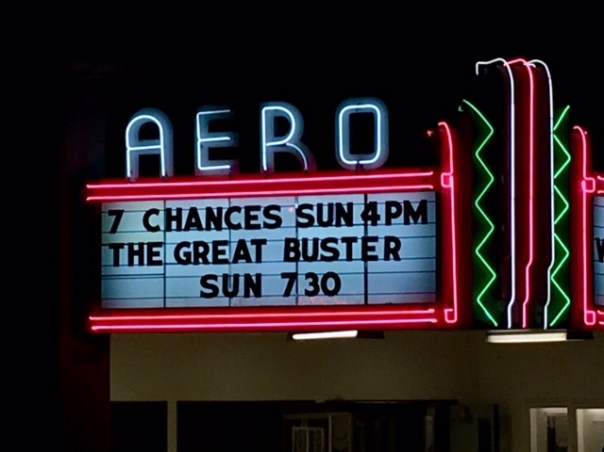
Aero Theater in Santa Monica
Before Nickelodeon theaters were all the rage, people flocked to theaters to watch actors perform vaudeville, a variety show and combination of burlesque, comedy, song and dance. One vaudeville veteran, Buster Keaton, was invited by Roscoe “Fatty” Arbuckle to play a small role in a two-reel comedy he was co-starring in and directing, “The Butcher Boy” in 1917. Keaton found his calling!
Buster Keaton went on to direct and star in films he made famous, “The General,” “Steamboat Bill, Jr.,” “Sherlock, Jr.,” “The Navigator,” “Go West,”, “The Scarecrow,” “The Paleface,” “Battling Butler” and “Seven Chances.” His deadpan face and humorous ways made us laugh at him and with him. He did anything for a laugh. He went to great lengths to perform the most incredible and dangerous stunts just for a laugh. He put his own body through a lot of damage. All in the name of entertainment.
Personally, I grew up admiring lots of characters that stemmed from the early days of cinema when everything was in black and white. Other favorites include Abbott & Costello, Laurel & Hardy and The Three Stooges.
I really liked Charlie Chaplin, but didn’t know the extent of his genius until I moved from New York to Los Angeles, California in 1992. And I barely knew of Buster Keaton really until I moved to LA. The Los Angeles County Museum was screening many of Keaton’s films for a few months in early 1994 I believe. Those screenings literally changed my life. I fell in deeper love and appreciation for the cinema and seeing movies on the big screen that I didn’t know was even possible. And I have Buster Keaton to thank for that. I even ended up making a few short silent films with a friend.
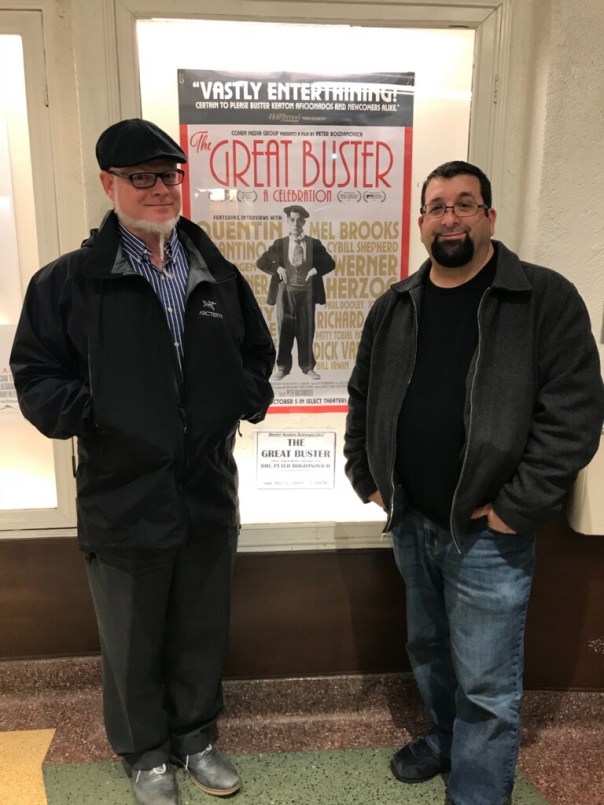
Seeing “The Great Buster” at The Aero with my friend, Sean Kinney, on the left.
Charlie Chaplin was someone I got a kick out of. While Keaton made audiences laugh at his expense, Chaplin’s humor was often politically motivated. “The Great Dictator” is an amazing accomplishment, poking fun at Adolf Hitler while Hitler was still in power. Both comedians took amazing risks in order to reach millions of viewers. Chaplin is known for “The Tramp,” “The Kid,” “The Gold Rush,” “Modern Times” and “City Lights” co-starring Buster Keaton.
Both Keaton and Chaplin along with other film artists such as Harold Lloyd helped kick off the passion that is the cinema. These funny, creative, innovative brilliant minds took us from the days of silent films into ‘Talkies’ an era where sound was added, giving actors a more realistic human feel. Talkies may have ended the silent movie phenomenon at the time, but silent films are still inspiring entertainment today everywhere you look. Keaton’s house falling on top of him, just missing him in “Steamboat Bill, Jr.” has been mimicked dozens of times in film, television and commercials.
Los Angeles also has the Silent Movie Theater on Fairfax Avenue in Hollywood. In the mid-90’s this place screened all sorts of silent films and with live organ accompaniment. It was a really hip thing to attend. There are still events today, but not as authentic as those days in the 90s.
Some of my earliest experiences with the cinema were in Minnesota where I lived as a kid. I recall seeing movies in a drive-in theater. I remember seeing “The Towering Inferno.” And my most endearing memories of cinema involve a gigantic dino-lizard named Godzilla, stomping through Japan and destroying Tokyo. Last year, 2019, The Egyptian Theater in Hollywood, California, did a revival of Godzilla movies and played back-to-back films in 35mm. I…was…in…heaven. Seeing and hearing Godzilla ROAR on the big screen put me right back into my childhood days.
Sidney Patrick Grauman built two of the most elaborate cinema landmarks in Hollywood; the Chinese Theater and the Egyptian Theater. My favorite movie theater to see larger-than-life movies is by far The Chinese Theater. The Chinese Theater opened May 18, 1927. A lot of the elaborate decor is of Chinese nature. And Chinese artisans designed sculptures to enhance the theater’s look and feel. The TCL Chinese Theater, as it’s now called, is absolutely breathtaking! The Egyptian is also quite amazing. Both theaters have very high ceilings like buildings that could have belonged to the Greeks, Romans or even the Egyptians perhaps in between the Pyramids.
When I was about six years old, my father took me to see “Star Wars, A New Hope” in 1977. I was FLOORED! What is this world of rebels, furry characters and dark figures breathing heavily into my face and psyche? I think my Dad, a huge movie fan was taken by it too, because we returned to the movie theaters to see it a second time. I believe we were going to see a different movie the third time, but whatever that movie was was sold out. No matter. I would spend the rest of my life seeing this movie, “The Empire Strikes Back” and “Return of the Jedi” whenever the chance presents itself on the big screen. That’s where these George Lucas movies were intended to be seen and for generations to come with the new Star Wars adventures.
My childhood was also very much influenced by Steven Spielberg. “Close Encounters,” although I didn’t quite understand it until years later, would have a profound affect on me. My sense of wonder about the world and the universe would blossom over the years. Soon it would be “E.T., the Extra-Terrestrial” that warmed my heart. And my sense of adventure was catapulted into existence by “Raiders of the Lost Ark.” All these movies seen first on the big screen is how I’ll always remember and think of them.
In my early adult years, Stanley Kubrick took over my mind. I think he stole it. Kubrick figuratively pulled back my eye-lids like in “A Clockwork Orange” and pulled me in to his worlds. “The Shining” is one of my favorite movies. “2001, A Space Odyssey” continues to affect me. The visual effects are absolutely dream-like and gorgeous. If anything was meant to be seen in 70mm IMAX, it’s “2001.” Much of Kubrick’s films, like Spielberg, were meant to be seen on large screens. Some of Kubrick’s larger-than-life films include “Paths of Glory,” “Spartacus,” “Lolita,” and “Dr. Strangelove or How I Learned to Stop Worrying and Love the Bomb.” Another wonderful film worth mentioning is “Full Metal Jacket.” Larger than life characters need to be seen and heard as big as the screens can be made.
The bigger the better! That’s why we need to support the movie theaters when unforeseen events force them to close for a period of time. Los Angeles is especially full of cinema history. And there’s outdoor venues, cemetery screenings, movies in the park, etc. Go see them all, but don’t forget the movie theaters.
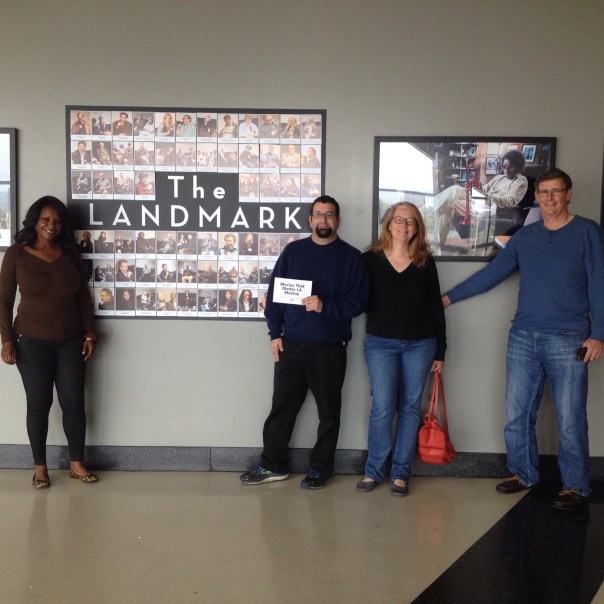
Movies That Matter movie Meetup at The Landmark.
When Laemmle Theater chain opens up again I plan to go see a movie to support bringing them back. They’re a smaller movie chain that often shows independent and/or foreign made feature films. Laemmle is just beginning to partner with a streaming company that will offer their movies on demand so they can survive in the meantime. Click here for more info., trailers and more.
AMC Theaters recently started on-demand to coincide with the regular box office theater option. I’ve been a member of their popular AMC Plus Pass which allows you to see three movies a week for $19.95 a month. They’ve suspended the cost for now while the theaters are temporarily closed.
For a few years I had a Meetup group called Movies That Matter LA. Usually I would pick a new release that involved a social issue related story. Often these movies were based on real people and true events. Some movies we saw were “Hidden Figures,” “Miles Ahead” “The Zookeeper’s Wife” and “Snowden.” One of the documentaries we saw was “An Inconvenient Sequel: Truth To Power” about climate change. My group would see the movie and then we would discuss it afterwards at a restaurant or coffee shop.
That’s me, Ross H. Martin, in the photo holding a Golden Ticket from “Willy Wonka & the Chocolate Factory,” one of my favorite movies. This screening with a Q & A took place at the NoHo 7 Laemmle Theater. It was part of a month-long celebration of Gene Wilder films.
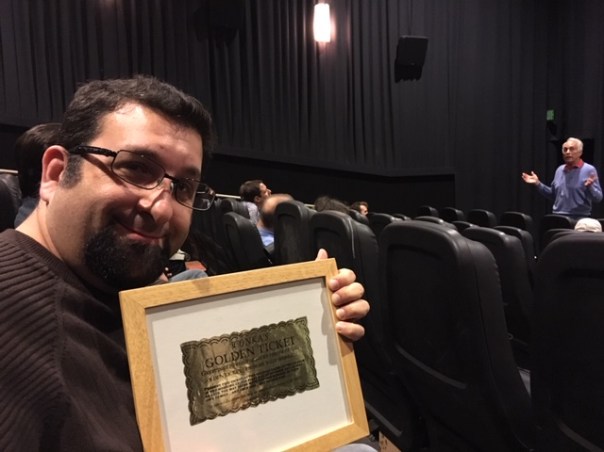
Laemmle NoHo 7
Originally called The Pacific Theatres Cinerama Dome, it opened November 7, 1963 with the premiere of “It’s a Mad, Mad, Mad, Mad World” in 70mm. Cinerama is a process that brings three synchronized movie projectors together displaying one-third of the picture on a wide, curved screen. The curved screen is an added touch to make the audience member feel more connected than watching on a plain flat screen.
What’s your chosen candy? I grew up eating anything chocolate. My go-to was Rasinets, Goobers or Nestle Crunch bars. And of course, popcorn. Although I can’t much popcorn anymore as it upsets my stomach. There’s nothing like kicking back and reclining in a stadium-made leather chair with a drink and snacks and watching a new movie release. I actually miss the old days when you could hear the plastic film running through the projector.
Today, projectors run digitally and very quiet. With technology getting better and better, movies are looking better and sounding better. Having worked at Fotokem post-production the past five years, I’ve witnessed the work being done on 70mm films still being produced by the likes of filmmakers Quentin Tarantino (“Once Upon a Time in Hollywood”) and Christopher Nolan. Just last night I watched “The Dark Knight” on my little TV screen. Yes, I need a bigger TV. But I recall first seeing “The Dark Knight” at the famous Arclight Cinemas in the Dome. Over 75 feet tall, the Cinerama Dome, another favorite theater of mine, is as impressive on the outside as it is on the inside.
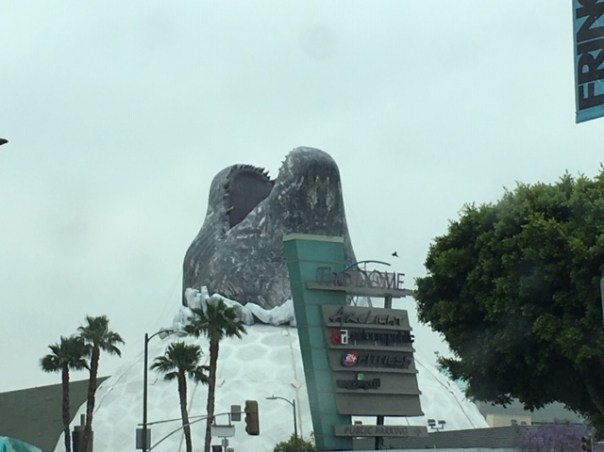
The Dome with Godzilla
Today, the Dome seats 800 people. At times, there is a display as a part of the giant white dome. When “Godzilla: King of the Monsters” (2019) was released you could see Godzilla’s face breaking out of the top and light shining from it symbolizing his nuclear energy zapping the heavens. The Arclight Theaters is also very big on quest speakers doing Q & As after screenings.
And after writing about these movie theater icons and theater chains, I may have to attend them all once they open back up for business. I’ll go see a movie at Grauman’s Chinese Theater (TCL Theater). Then maybe I’ll catch a movie at the Dome. I’ll definitely go support Laemmle Theaters.
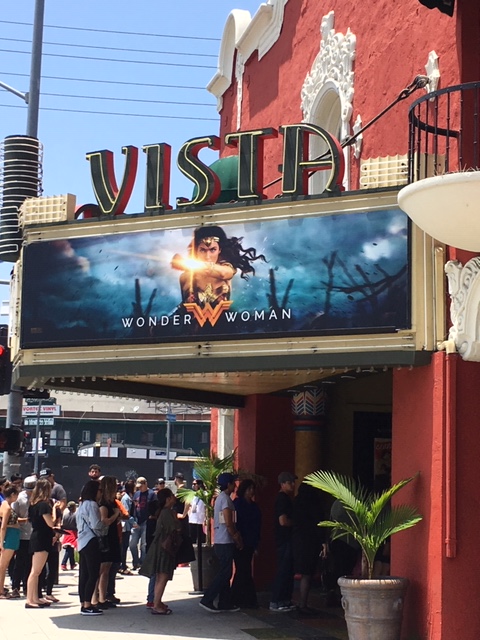
The Vista Theater playing “Wonder Woman.”
And now I’m reminded of another great movie theater in Hollywood. The Vista Theater, opened as early as 1923, holding 400 seats. It plays newly released movies as well as classic movies of the past. Last year, at the Vista I saw “Batman: The Movie” (1966). It was the first time I had seen it in a theater and it was wonderful. All the cheesy dialogue and action made me feel all warm and fuzzy.
At Vista the manager or ‘epic manager’ as he is often referred to as, Victor Martinez, is very much like a showman, dressing up at his premieres. He even recruited Wonder Woman.
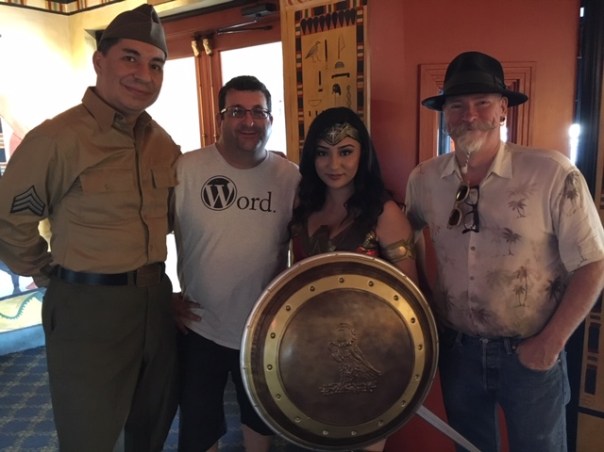
Vista Theater Wonder Woman Premiere. My friend, Michael McLaughlin, is on the far right. Manager Victor Martinez, far left.
And finally, with my re-instated AMC Plus Pass, I’ll return to doing what I love most, seeing movies in the theaters.
We in our 40s grew up with so much change at the cinemas. We look forward to bigger and better. Younger people can look forward to those awkward first dates. The movies give them something to break the ice afterwards. Some hand-holding. Sharing popcorn. Maybe a scary horror film makes one lean on the other. These couples will have families and take their children to see the newest animated film and perhaps see them in 3-D. Enjoy!
See you at the movies!
Share this:

The Passion Controversy
‘The Passion Controversy’ Extended Version
The following article was written in 2004. Although the movie, “The Passion of the Christ” was released in 2004 as well, the issues between Jews, Christians and other faiths unfortuantely continues.
On Wednesday night, March 3rd, 2004, a small discussion group of Jews congregated at Kol Tikvah temple in Woodland Hills to discuss the film, “The Passion of the Christ.” There was an enormous amount of tension stirred up. Only a handful of about twenty-five citizens had seen the film that had only been in theaters a few weeks. One father spoke about his distraught seven-year-old daughter telling him that another young girl teased her in school, calling her a ‘Christ killer.’
Rabbi Steven Jacobs, an advocate for interfaith relations, who lead the discussion at Kol Tikvah, was invited to numerous similar discussion groups since the film’s release. His Catholic friend, Bernard White, invited him to lead a forum at the Church of Blessed Sacrament in Hollywood on March 30th. Jacobs was then invited to speak by Bella Vita retirement community at the Sportsmen’s Lodge in Studio City on April 22 with the Rt. Reverend Alexei Smith and moderated by Sam Rubin from KTLA News. The following reactions and observations are taken from these meetings.
To Jacobs, the cross in the film represented the crucifixion of the Jewish people. The cross conjured up visions for the rabbi of “a million and a half Jewish children hanged. Ninety-percent of Eastern Europe being decimated. Eight out of ten rabbis in Europe slaughtered.” The rabbi said, “Who can reasonably expect that I can see this picture of priests in crowds draped with prayer shawls hovered over by a she-devil without a measure of paranoia?” He said that for two thousand years the Jews have been accused of killing Jesus. Regarding the film, the rabbi said, “In two hours, Christians watched their savior tortured and killed. For the same two hours, Jews are watching Jews arrange the torture and the killing.”
The rabbi said that the Jews in the film, except for Jesus’ disciples, are few and often sadistic. Although the rabbi was very prepared for the story and the characters involved, the depiction of the Jews was still very upsetting to him. Jacobs mentioned his anger to some of his liberal Christian friends. One of his dearest friends, a very sensitive Presbyterian from a church in Atlanta thought it was the most beautiful movie. Jacobs’ Presbyterian friend asked him what upset him so much and added that there’s nothing anti-Semitic about the movie. Rabbi Jacobs said, “Let me tell you what my worry is. It’s not here in the United States. What’s going to happen when it’s shown in Arab countries? He said, ‘I never thought about that.’”
The rabbi expressed his concern of the outcome after playing in countries already so hostile towards Jews. The concern can make Jews paranoid. Jacobs says that it’s not paranoid that the movie is made by one of the world’s superstars depicting Jews as having Christ tortured and killed. The rabbi said, “It is for example difficult to imagine that this film will not be a hit in the anti-Semitic Arab world even though Islam denies crucifixion.”
The rabbi talked about May 2001 when Syria’s dictator, Assaud, greeted Pope John Paul II at the Dimascious Airport. Assaud’s welcoming speech was about the Jews’ betrayal of Christ. Jacobs said that it’s essential that Christians understand that every Jew, no matter what affiliation such as secular, religious, left wing, right wing, fears being killed because of being Jewish. “It is the only universally held sentiment amongst Jews,” said Jacobs.
The rabbi added that what Jews need to understand is that most American Christians watching this film don’t see the Jews as the villains. “Most American Christians, Catholic and Protestant, I believe, believe that a civic or city humanity killed Jesus, not the Jews,” said Jacobs.
Jacobs then mentioned that for most Christians it was God who made Jesus’ crucifixion happen, not the Jews or the Romans. The rabbi said that a book of mentions this and that Christians feel that Christ’s entire purpose was to come to this world and be killed for humanity’s sins. Jacobs said, “Most Christians now regard a Christian who hates Jews for what he believes in some Jews did two thousand years ago. The way you regard such a person is a moral, intellectual and a religious low life. Imagine what Jews would think of a Jew who hated Egyptians after watching the Ten Commandments and you get an idea of how most Christians would regard a Christian who hated Jews after watching The Passion.”
Father Alexei often talked about Nos Aetate, a documented event that will soon be celebrating its 40th Anniversary. It is the Catholic Church’s declaration on its relationship to non-Christian religions. This document revolutionized the way the Catholic Church looks at non-Christian faiths. Alexei mentioned that the Catholic Church rejects nothing that is true and holy in these religions. He says that Nos Aetate further mandates that change in their relationship with these faiths particularly a change in their relationship with Judiasm.
Rabbi Jacobs didn’t like the fact that Jesus’ trial occurred at night. Jewish law prevented trials to take place at night. According to the rabbi, Poncious Pilot comes across as too compassionate. A man in the audience asked about what the Jews are taught about Poncious Piolt. The rabbi said that very little is taught in Hebrew school about Pilot.
The rabbi mentions the Seder, Passover scene and how Jesus expressed his love for humanity. He would have preferred the film to show a little more of the resurrection because, as powerful as the crucifixion is, “the resurrection is what is so powerful about humanity.”
A man in the audience asked a question about the line or sentence asked by Jews, “May the blood be upon our heads and the heads of our children,” taken out in English, but left in Aramaic, Sam Rubin responded by asking the panel if one line mattered. Father Alexei said that it depended on the line. Alexei added that whole quote has been used a lot in anti-Semitic thought. The Father addresses the man in the audience, “I’d like to caution you about something you said. Officially, the line says that the Jews said this. Well, again. We’re trying to teach our people not use that term broadly when it comes to the passion narratives. Not every Jew has originally said that. The leader of the gospel quotes, that text, that same through a leader of the Jews. Not all of the Jews. Does that mean that he is speaking on behalf of all the Jewish people? I don’t think so,” says Father Alexei.
Rabbi Jacobs disliked the portrayal of the crucifixion in the film due to Gibson relying on a source that was an 18th Century anti-Semitic nun. Another problematic element of the film for Jacobs is it’s opening usage of the passage of Isaiah. Jacobs stated how the New Testament is misleading and suggests that Jesus was born to a virgin. The rabbi said that the original Hebrew of that verse uses the word, alma. Alma means a young woman. It does not mean a virgin. The rabbi indicated that when something is translated into a language and then translated into another language, it’s very likely to misinterpret the original meaning. “If you see it in print you believe that. That’s the way history is about. It’s the way you see the Bible, you see the Testament written in a particular kind of way,” said Jacobs. The rabbi said that such sources and scriptures need to be put into perspective. Jacobs mentions that in Jewish tradition it is called mid-Rush. A section is taken and elaborated on to create stories around it. “You have to understand what (gospel) writers did,” said Jacobs. “They weren’t there.” Rabbi Jacobs said that Mel Gibson is entitled to tell his version of the story of Christ.
Rabbi Jacobs talked about how it’s difficult to escape the anti-Semitism that comes out of Gibson’s father’s mouth. Jacobs talked about how Mel Gibson responded in the interview with Diane Sawyer. “I don’t think I’d say ‘Let’s not go there.’ I would say that my father has his own thoughts. I do not share them. I think that that would have gone a long way,” said Jacobs. The rabbi added, “You cannot visit the sins of the parents upon the children. That’s that line from Isaiah. It’s removed. By the way, it’s removed in English about visiting the blood and the children. It’s not removed in the Aramaic. In the countries in which it will be seen that will have an even greater impact.”
The rabbi thinks that Mel is angry with certain people in the Jewish community. Rabbi Jacobs said that he would have waited and would not have had Jews say anything about the movie. Although Gibson didn’t preview the film for Jews, he didn’t let Jews in. Jacob’s criticism of Gibson is that in the movie and about Jesus because Jesus was there to tell the truth. According to Jacobs, Mel Gibson didn’t adhere to that. Gibson didn’t let people, especially Jews, in to the movie for preview screenings.
Father Alexei added that Mel Gibson rejects certain teachings of Vatican II. The Father said that Gibson rejects the teaching of Nos Aetate. Alexei mentioned that Gibson built two chapels in the cities of Agoura and Malibu. Alexei said that he works at the Cardinal’s office and hears the switchboard operators handling calls from people wanting to know the address of these churches. Father Alexei said that these churches are not recognized by the Archdiocese and they inform those callers where their Roman Catholic parish in Malibu, Our Lady of Malibu, is located. Alexei added that his church was not pushing anyone there. “We are in fact by saying that telling them they are not ordained by the Archdiocese. It’s sad that some of our people don’t accept it,” said Alexei. “We pray for everyone, but to these people in particular that they might open themselves up.”
Jacobs added that Gibson’s got to come to terms with his faith and what the differences are about. Rabbi Jacobs believes that people follow certain patterns in their lives. Jacobs’ feeling is that Mel Gibson was troubled and identified strongly with his own guilt and his own pattern. He also believes that the scene in which Gibson’s hand is the actually hand that puts the nails into Jesus has a great deal to do with Gibson’s past. “People can be very critical of me because I follow certain patterns in my life. I’m very involved in political activity because I believe religion and politics go hand in hand. I believe in change. If you believe in God of the status quo, that’s a political position. It kind of relocates religion to being an ambulance chaser, I guess. I really believe in a prosthetic faith. I believe in a good deal of what Jesus had to say of the gospels, of what I know about Jesus,” said the rabbi.
Jacobs thinks that it would have made the movie experience that much better. Jacobs would not have let his Catholic friends stand up and talk about the movie and not make it a Jewish-Christian connotation. Jacobs believes that including Jews earlier on would have prevented the film from appearing to be anti-Semitic and Jews that did get to see preview screenings may not have jumped the anti-Semitic bandwagon.
Sam Rubin asked the Rabbi and the Father if people were better off with or without the movie. “In the beginning I felt very uncomfortable and I wished that it not been produced. I was concerned that part of the fabric that we built together would be desecrated,” said Rabbi Jacobs. Although he seems to remain upset about certain elements in “Passion,” Jacobs realizes the great opportunity for interfaith communities to discuss the film with each other. The rabbi says that it’s easy to talk about truths within your own congregation, but it’s very difficult to discuss truths with other communities of different faiths. “I’m involved in the interfaith world, but I’ve never had so many invitations since the movie has come out. It is a time to speak truths. And for people who have grown up on the gospels or who really don’t understand their Christian religion to understand how Jews feel about this movie. So I’m pleased. I’m pleased now. In the beginning I was not,” says Rabbi Jacobs.
Father Alexei mentions how the film has caused him a great deal of work, but he looks at that work as a “golden opportunity” and that he and the rabbi brought together a large amount of people that wouldn’t have had that opportunity before. Father Alexei says that the opportunity reminds people to learn about other faiths. “What the archdiocese and I share a number of inter-faith dialogues with the Buddists, for example, with the Hindus. Imagine this film was the hot topic in our dialogue sessions. They wanted to know what it was all about. They wanted to know what the controversy was or to raise their awareness of where the Jews are coming from,” says the Father who adds how the Buddhists also wanted to know where the church was coming from.
“My initial anger gave way to something else. There’s a part of me that wants to invite Mel Gibson not in any patronizing kind of way to come and to dialogue with me in the synagogue. Let him do it in the synagogue. I would like that,” said Jacobs.
The rabbi then mentions that this is the positive side of the outcome of the film. “This is an opportunity for us to begin, for Jews to begin, not only to understand our own tradition, but to understand what Christians believe,” says Jacobs.
“I have over these few weeks, emerged in a way in which I wanted to communicate about the goodness of our lives together and even when we differ be able to understand the film that I saw as a Jew and the film that you saw as a Catholic, as a Christian. That’s the way we move ahead in this world,” says Jacobs.
Rabbi reads a memo by another rabbi colleague of his that really inspired him. “I was moved by Jesus’ forgiveness of his tormentors and by the way he saw himself and his fame as fulfilling God’s plan for the world. As a Jew this plan is not what I understand God to desire for the world, but this is a Christian movie, Jesus’ forgiveness and gentleness was profound. There was strength in Jesus’ knowing submission to the word of God.” Rabbi Jacobs interrupted reading the memo to remind the audience that this memo is from a rabbi. “I was also moved by the portrayal of the people closest to him…And they suffered with him as he suffered. They cleaned up his blood. They accompanied him to his crucifixion. After all have left they waited there until he died. Jesus’ suffering repelled them as anyone would be repelled to see their loved one in pain, but they bore him witness. You could feel them wanting to escape or flee. But they would not leave Jesus alone. That was moving to me and that would be moving to anyone.”
Rabbi Jacobs said, “We can learn from each other because ultimately that’s what this film is about. I think the only way we’re going to make it is by understanding one another. There are more of our similarities than our differences.”
Sources
Discussion group with Rabbi Jacobs and Father Alexei and Sam Rubin of KTLA at Sportsmen’s Lodge April 22, 2004 – Sponsored by Bella Vita.
Discussion group with Rabbi Jacobs at Blessed Sacrament Church March 31, 2004
Discussion group with Rabbi Jacobs at Kol Tikvah March 3, 2004
Share this:

“Godzilla!” Shouted No One
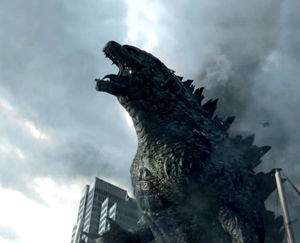
Godzilla 2014
There are a good amount of movies out now as the Summer movies kick in. The one movie I was dying to see I finally saw tonight. He’s tall, rough and green, but not really that mean. Yes, I saw “Godzilla.” I wasn’t expecting the greatest movie ever, but had heard some good reviews. One thing I had heard beforehand a few times was how good Bryan Cranston is and how he should have been in the film more.
The screenplay is very good. It’s such a great set-up at the start with Cranston’s Joe Brody losing his wife that I felt they could have kept him on to help out. Ken Watanabe’s character, Dr. Ishiro Serizawa, points to Cranston’s character, Joe Brody and his son, Lt. Ford Brody (Aaron Taylor-Johnson) and says he wants ‘them.’ Really, he wants Joe Brody who knew why things were happening and was tracking these frequencies and seismic events. Joe Brody was by far the strongest character. Aaron (“Kick-Ass”) plays a solid lead, but the audience member isn’t truly rooting for him like they were or at least I was for his father. There’s this picture Joe finds of himself, his son and his wife when he investigates his old home and then its discarded. It’s cliche, but would have made a nice emotional connection and possible moment for the son to have the photo and re-connect with his mother. We do see that Lt. Brody has a photo of his own wife and son, but it doesn’t ring as truthful. And although Lt. Brody leads some great action, the title of the film is “GODZILLA.” [INSERT LOUD DINOSAUR ROAR HERE]. I felt like the battle between Godzilla and these other ancient creatures, the MUTOs, were more in the background and the military were more in the spotlight. As soon as Nevada was mentioned I knew they were going to Yuca Mountain and sure enough there it was. One of the MUTOS found there goes and destroys Las Vegas, but we see it through TV and other screens. It would have been nice to see and hear the creature damaging casinos and seeing tourists there run for their lives, but perhaps it was a budget call. (I hope the creature left Downtown LV alone as I really like it and Summerlin since my parents live there. Better call Mom & Dad tomorrow and make sure they’re okay. Perhaps Tony Hsieh bribed the ‘female’ creature with a million boxes of shoes. She was pregnant after all. Zappos would probably have to work out the size issue. )
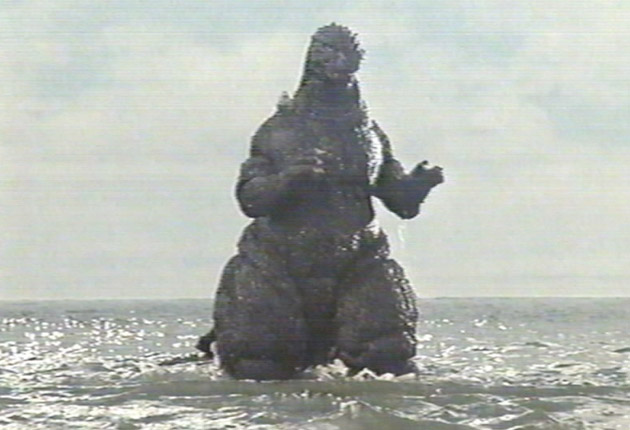
Godzilla Old School
For a moment I thought there might have been an interesting exchange between Lt. Brody and Godzilla as both were battling these creatures, but had some sort of mutual respect for each other. Perhaps this was a missed opportunity for a connection. The only other thing I would have liked to have seen is a little more recognition of Godzilla being a hero. The following is definitely a missed opportunity! This poor Japanese boy gets stuck on the train away from his parents and Lt. Brody looks after him. Wouldn’t it be a perfect callback to have this little boy at the end shout “Godzilla!” He could have been watching it on TV maybe with his parents.
I’m picking on a few things here, but I really enjoyed it. A great popcorn film! I sneaked in some chocolate into the AMC in Marina Del Rey. I wanted to check out AMC and its wonderful luxury seats. Frankly, I had been in a theater like that before. I’ve taken forever to go to this theater as seats are $20!!! I was comfortable and opened the seat to lay down, but I didn’t need the waiters and waitresses interrupting throughout the movie. Water or a Coke shouldn’t cost $5 either. There’s always Pacific Theater down the street in Culver City. (I wasn’t going to make the 7:45pm showing in Culver City so I opted for the 9:30pm show at the AMC.)
I purposely skipped the 1998 Godzilla remake as it looked cheesy. This 2014 version at least makes Godzilla some sort of hero. He’s always been my hero. Godzilla is a symbol for my childhood. I must have seen a few Godzilla films at the Drive-Ins as I remember, but I definitely and religiously watched Godzilla movies growing up. To me, Thanksgiving and some other holidays meant a bunch of monster movies would be on back to back. King Kong, Jason & the Argonauts, Laurel & Hardy, etc. Those were the days. Go go Godzilla!
Share this:

Luxury+ Galaxy Theatres Re-Open with a Bang!
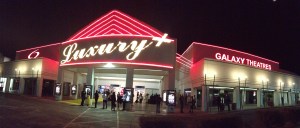
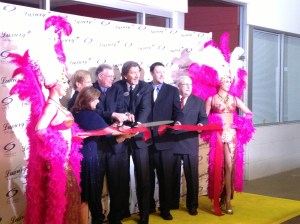
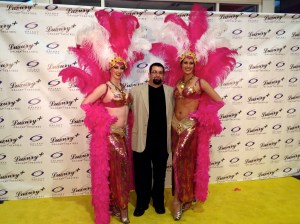
It’s been roughly eight years since Galaxy Theatres closed down in the Green Valley Town Center of Henderson, NV. Thursday, March 7th, 2013, was the night of the Grand Opening. It was a magical kick-off with free popcorn, wine and a ‘yellow’ carpet. I was lucky enough to be invited by an associate, Juergen Barbusca. I had gone to the Galaxy Theatres in Los Angles, CA, but this theatre was new to me in many ways.
A ribbon-cutting started things off. Of course, Henderson is very much a part of Las Vegas. And Las Vegas is nothing without showgirls.
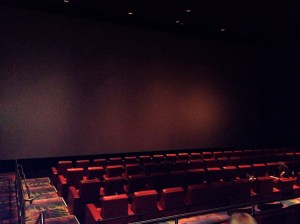
IMAX-sized Screen!
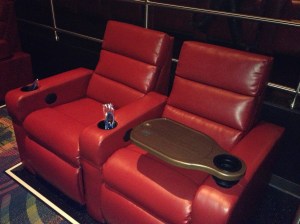
What makes these eight movie theatres luxurious? Well, for one, you can order alcohol. Two of the eight screens are IMAX size. There’s plenty of room in each aisle. And then there’s the comfy, reclining leather seats! Unless a customer is in the IMAX theatres or watching a 3-D movie, prices will reflect regular movie prices. WOW! And reclining seats include food trays. What else do you need? You’re in movie-going heaven!
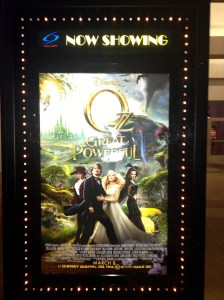
Oz, The Great and Powerful
As if all of this wasn’t enough, the movie the theaters were screening that night was “OZ, The Great and Powerful.”
We got a unique preview of the film before its official opening. So, I did what was natural. I placed my popcorn and drink on the tray.
Then I reclined the leather seat so I could feel at home. Hopefully, the Luxury+ Galaxy Theatres will be open for many, many years to come.
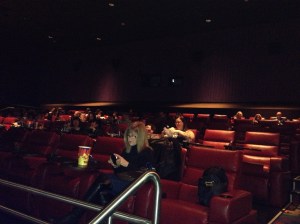
Leather Reclining Seats
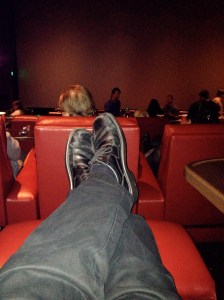
Reclining Ross


